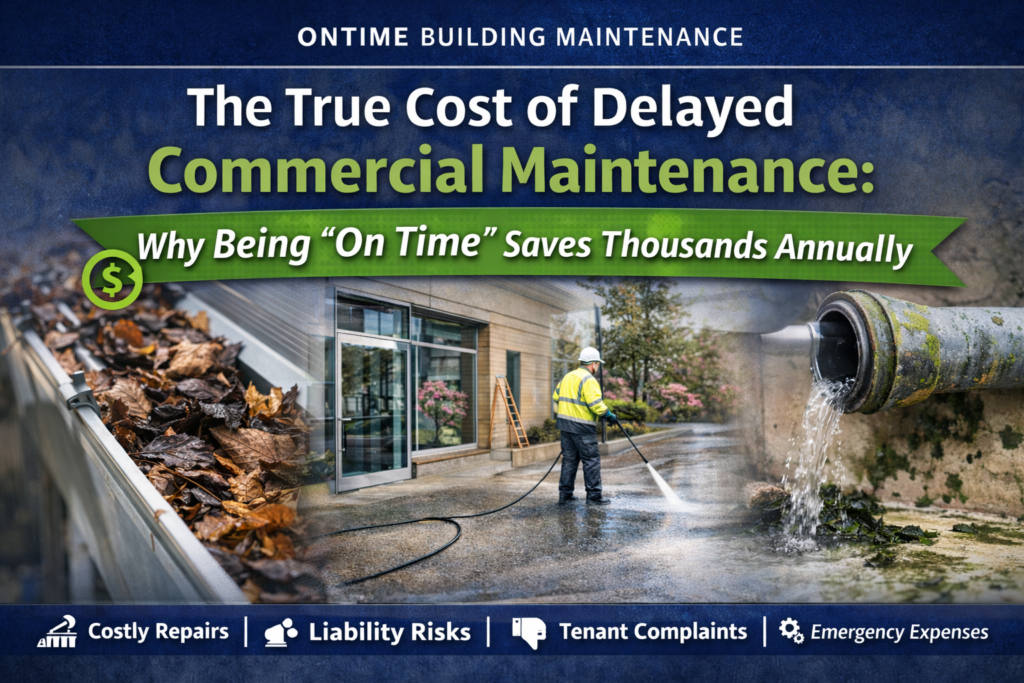
In commercial property management, timing is not a minor detail — it is a financial strategy.
Many property managers delay routine maintenance in an effort to control short-term expenses. However, postponing preventative services almost always leads to significantly higher long-term costs.
At Ontime Building Maintenance, we’ve seen firsthand how proactive, scheduled maintenance protects assets, stabilizes budgets, and prevents avoidable emergencies.
Here’s the real financial impact of delayed commercial maintenance — and why being “on time” truly saves thousands annually.
1. Minor Issues Escalate Into Major Repairs
Commercial buildings operate as integrated systems. When one small issue is ignored, it often triggers a chain reaction.
Examples include:
- Clogged gutters leading to roof leaks and structural water damage
- Dirty HVAC filters causing system strain and premature equipment failure
- Neglected flooring resulting in permanent surface damage
- Drain blockages causing interior flooding
- Moisture buildup creating mold remediation situations
The cost of routine maintenance is predictable and manageable. Emergency repairs are not.
Preventative service costs a fraction of structural restoration or equipment replacement.
2. Asset Lifespan Is Directly Tied to Maintenance Timing
Commercial properties represent substantial capital investments.
Every component — roofing, flooring, mechanical systems, exterior surfaces — has a projected lifespan based on proper care.
Routine maintenance extends the lifespan of:
- Commercial carpeting and VCT flooring
- HVAC systems
- Roofing membranes
- Concrete surfaces
- Common area fixtures
Even extending asset lifespan by 3–5 years can translate into tens of thousands of dollars in deferred capital expenditures.
Being “on time” protects asset value.
3. Vancouver’s Climate Accelerates Wear and Tear
The Lower Mainland climate presents unique maintenance challenges:
- Heavy rainfall
- Persistent moisture
- Organic debris accumulation
- Seasonal temperature fluctuations
Without consistent servicing, moisture intrusion and environmental exposure deteriorate surfaces much faster than in drier climates.
Routine gutter cleaning, pressure washing, floor care, and moisture monitoring are not optional in this region — they are preventative safeguards.
Delays amplify environmental damage.
4. Delayed Maintenance Increases Liability Risks
Commercial property owners and managers carry significant liability exposure.
Common risks include:
- Slip-and-fall incidents due to neglected floors
- Water damage from blocked drainage
- Mold exposure claims
- Poor lighting or unsafe common areas
Routine maintenance ensures:
- Safe walkways
- Clear drainage systems
- Clean and compliant common spaces
- Documented service logs
Being on schedule reduces legal risk and protects reputation.
5. Reactive Maintenance Disrupts Budget Stability
Emergency repairs create financial volatility.
Unplanned expenses:
- Disrupt operating budgets
- Delay other capital improvements
- Increase stress for management teams
- Often require premium emergency service fees
In contrast, preventative maintenance programs provide:
- Scheduled service intervals
- Predictable monthly or quarterly costs
- Transparent scope of work
- Controlled long-term budgeting
Financial stability begins with consistency.
6. Tenant Satisfaction Depends on Reliability
In strata and commercial rental environments, tenant perception directly affects retention.
Neglected buildings lead to:
- Increased complaints
- Lower renewal rates
- Reduced property value
- Negative online reviews
Well-maintained facilities communicate professionalism, stability, and care.
On-time maintenance builds trust.
7. The Compounding Cost of “Waiting”
Many decision-makers delay maintenance because “it’s not urgent.”
However, deterioration compounds over time:
A minor crack becomes water intrusion.
Surface wear becomes structural damage.
Simple cleaning becomes material replacement.
The longer maintenance is postponed, the more complex and expensive resolution becomes.
Timeliness is the most cost-effective maintenance tool available.
What On-Time Commercial Maintenance Should Include
A structured program typically includes:
✔ Routine janitorial services
✔ Pressure washing and exterior cleaning
✔ Gutter and drainage maintenance
✔ Floor stripping, waxing, and carpet care
✔ Seasonal inspections
✔ Moisture monitoring
✔ Common area upkeep
Consistency is more valuable than intensity. Smaller, scheduled services prevent large-scale corrective work.
Why “On Time” Is More Than a Name
At Ontime Building Maintenance, we believe proactive service is the foundation of responsible property management.
Our structured maintenance programs are designed to:
- Prevent asset deterioration
- Protect tenant experience
- Reduce emergency repairs
- Stabilize long-term costs
- Preserve property value
Commercial buildings perform best when maintenance is predictable, preventative, and professionally managed.
The Bottom Line
Delayed commercial maintenance is rarely a cost-saving strategy. It is often a cost-multiplying mistake.
Being on time:
Protects capital investments.
Extends asset lifespan.
Reduces liability exposure.
Improves tenant satisfaction.
Stabilizes operational budgets.
For commercial property managers in Metro Vancouver, preventative maintenance is not optional — it is essential.
In building management, timing is everything.
And being “on time” saves thousands annually.